We have tried to cover the Adidas Sustainability Report to provide a concise overview of its sustainability policies across environmental management, pollution, circularity, and biodiversity throughout its operations.
Adidas is one of the leading companies in the footwear and fashion sector, and its sustainability performance matters because the industry is one of the world’s largest contributors to emissions, resource consumption, and environmental impacts across its value chains.
This article examines the company’s latest sustainability status through the lens of climate, pollution, water, circularity, and biodiversity, highlighting where it is making progress and the initiatives it is implementing to address environmental challenges.
The goal of this update is not to promote the company, but to provide a clear, report-style snapshot of what it is doing in sustainability.
“fashion production comprises 10% of total global carbon emissions, as much as the emissions generated by the European Union”
earth.org
Adidas Sustainability Report of total GHG emissions along the value chain
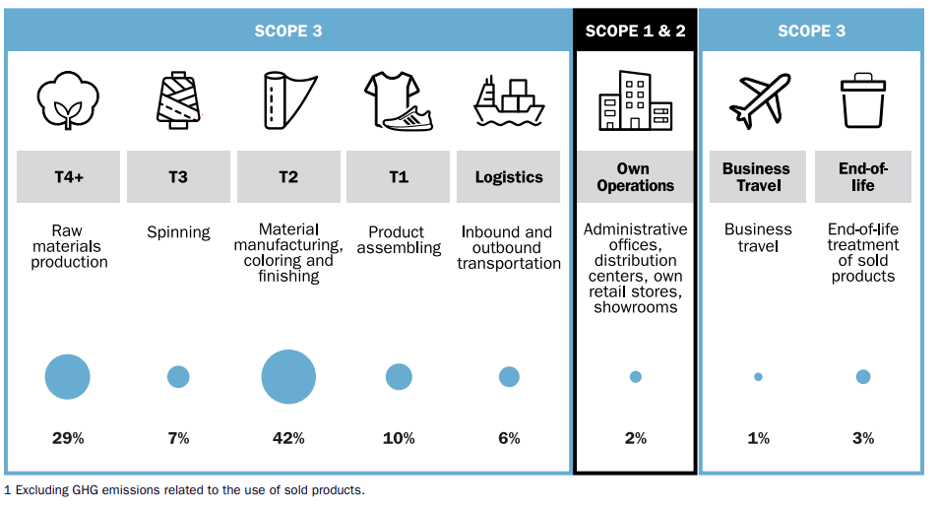
adidas faces its greatest sustainability challenges in its upstream value chain. More than 97% of its emissions come from the supply chain, primarily from manufacturing and raw material production.
Net-Zero by 2050
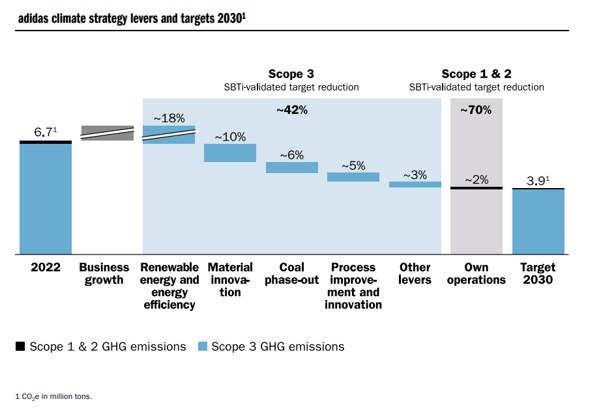
Adidas’ climate roadmap focuses on a combination of clean energy, supplier decarbonization, lower-carbon materials, and manufacturing innovation to achieve its 2030 climate targets.
Adidas Raw Material Procurement
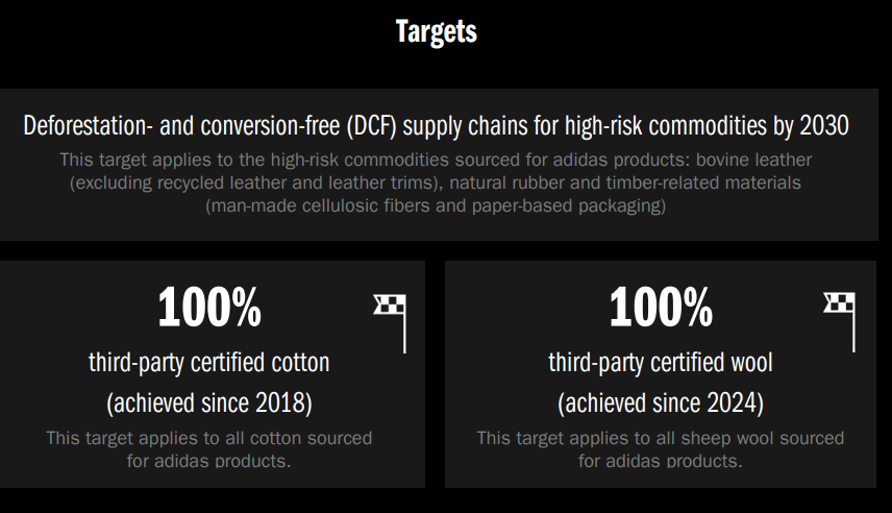
In 2025, adidas began rolling out its Biodiversity and Ecosystems Policy while continuing to focus on material traceability, material innovation, and industry collaboration to drive positive change.
Resource Use and Circular Economy
The fashion industry uses significant amounts of resources, from raw material extraction to intensive manufacturing processes, creating environmental impacts throughout a product’s lifecycle.
Product disposal also creates environmental challenges, including pollution, limited circular solutions, and inadequate recycling infrastructure in many developing nations.
To help address these challenges, adidas uses recycled and sustainably sourced renewable materials.
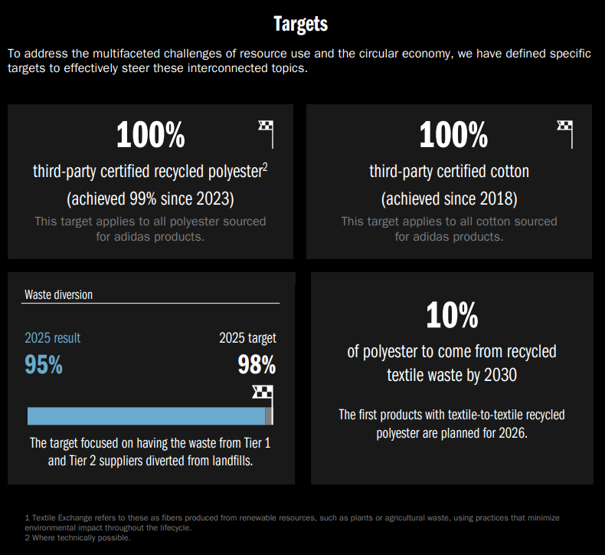
Adidas sources 99% of its polyester from third-party certified recycled sources, a milestone achieved in 2023.
Additionally, over 95% of waste from Tier 1 and Tier 2 suppliers is diverted from landfills.
Materials used in adidas’ products and packaging in 20253
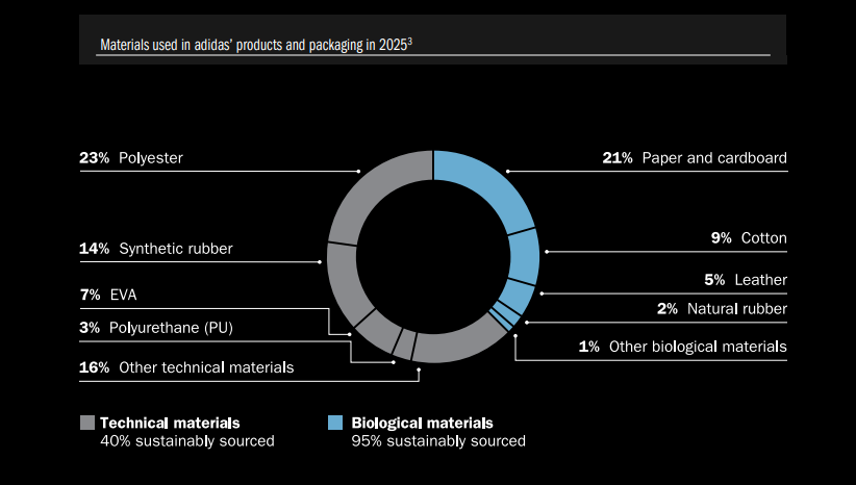
The graph above indicates that approximately 40% of materials are still plastic-based. Due to the complex mix of materials used in footwear, shoes remain difficult to recycle at scale.
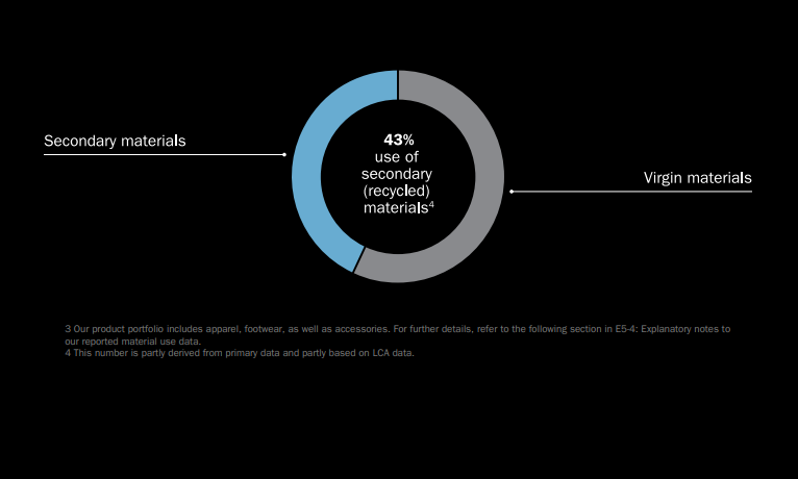
It is encouraging to see that 43% of materials are sourced from recycled inputs.
Recycled Polyester / Materials Visuals
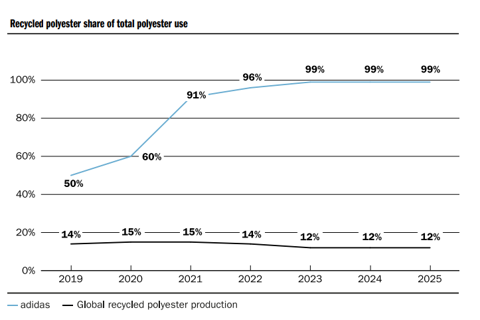
Adidas has nearly eliminated virgin polyester from its products, marking one of the largest material transitions in the sportswear industry.
Emissions
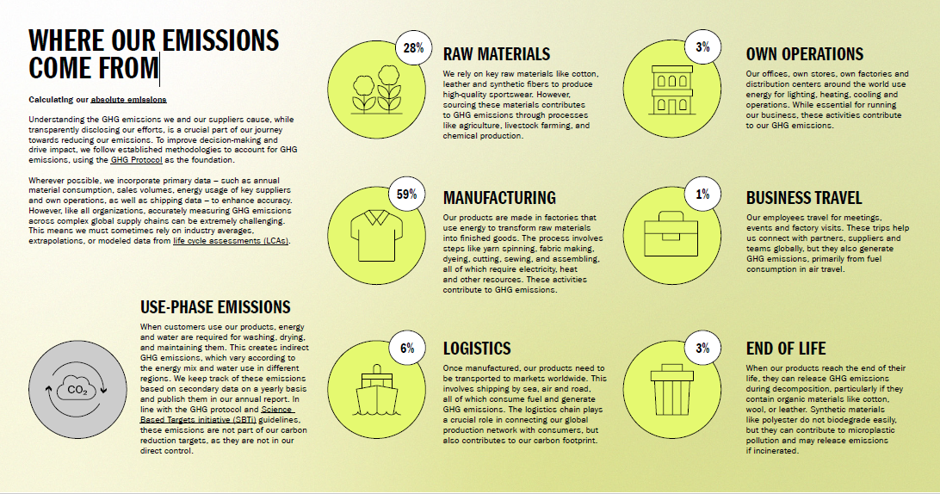
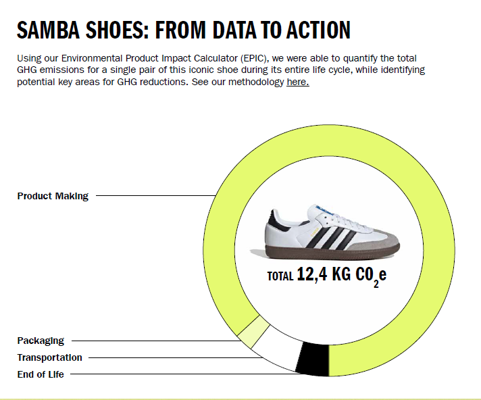
Manufacturing is by far the largest contributor to adidas’ greenhouse gas emissions.
Manufacturing is also one of the largest emissions contributors across the wider fashion industry.
Focusing sustainability efforts on manufacturing can therefore deliver some of the most significant environmental benefits.
“The Quantis International 2018 report found that the three main drivers of the industry’s global pollution impacts are dyeing and finishing (36%), yarn preparation (28%) and fiber production (15%).” earth.org
This highlights an important reality that climate impact is primarily linked to how products are made rather than how they are sold. Therefore, sustainability efforts should be centered on manufacturing to create the most significant impact.
Raw materials contribute 28% of total emissions, making them the second-largest emissions source.
Together, raw materials and manufacturing account for over 87% of adidas’ total emissions.
Logistics and global transportation account for over 6% of total emissions, including transporting products to markets, moving goods across global supply chains, and delivering products to distributors and retailers.
“The transport sector accounts for roughly 15 per cent of total greenhouse gas emission”
UN
Products’ Emissions
Supplier Renewable Energy / Coal Phase-Out Graphics
Emissions reductions
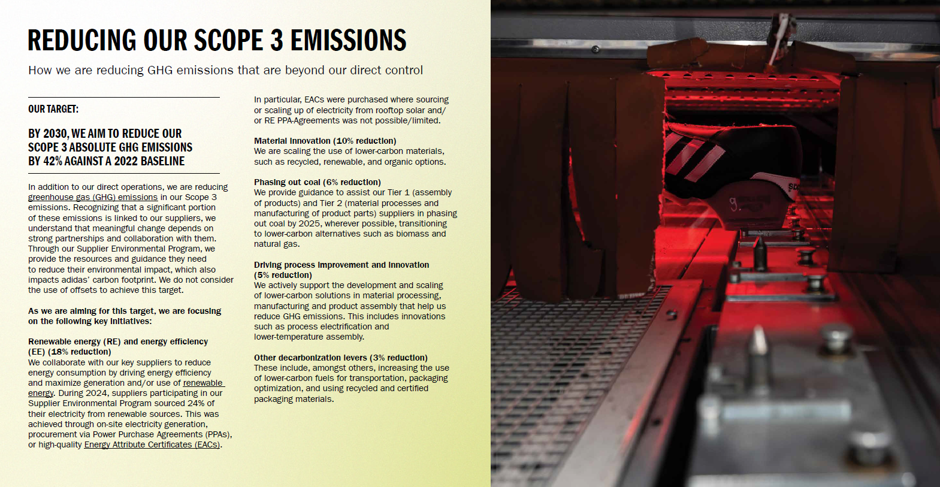
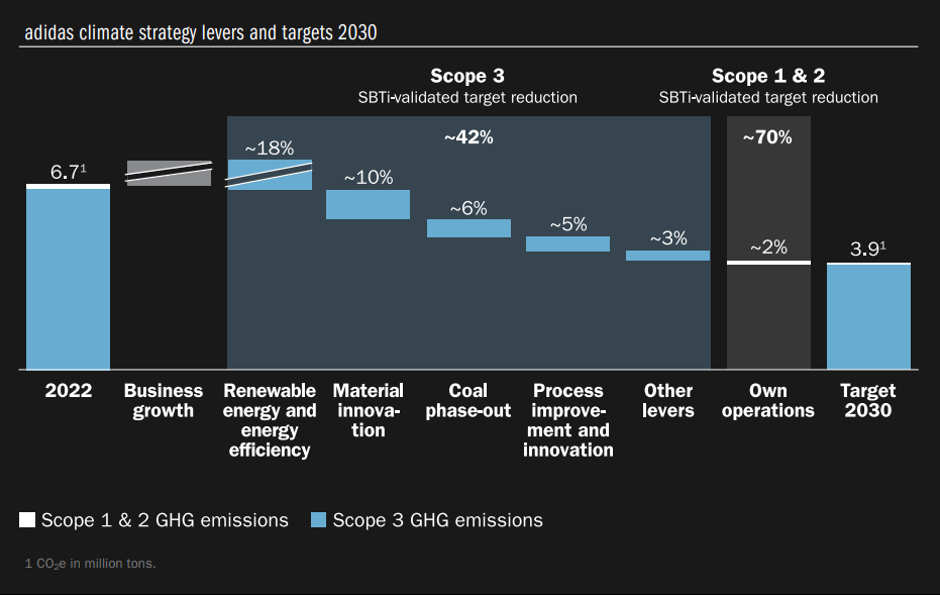
adidas has set plans to reduce Scope 3 emissions by 42% by 2030 compared to its 2022 baseline. As discussed above, manufacturing and raw materials are the major contributors to these emissions, with the company focusing primarily on supplier collaboration and operational transformation rather than relying on carbon offsets.
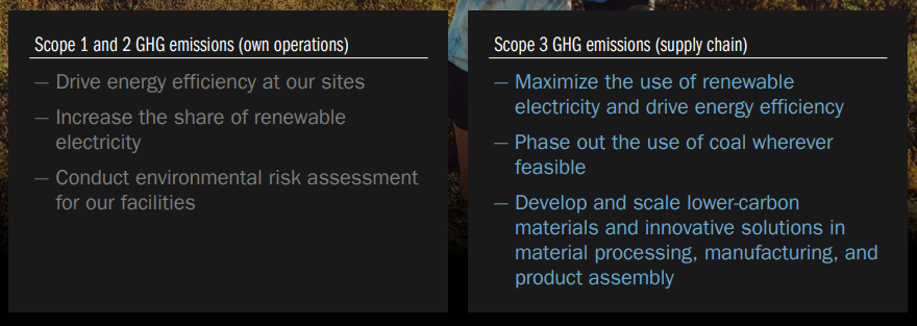
adidas’ decarbonization strategy is built around several key elements. One of the primary contributions is expected to come from renewable energy and energy efficiency initiatives, which could contribute an estimated 18% reduction through supplier energy improvements, rooftop solar systems, and other renewable energy agreements across manufacturing facilities.
Another major area is material innovation, contributing an estimated 10% reduction through the increased use of lower-carbon materials such as recycled, renewable, and organic alternatives.
One of adidas’ major plans is to phase out coal usage across its Tier 1 and Tier 2 suppliers, helping the company achieve a further 6% reduction by transitioning to cleaner energy alternatives such as biomass and natural gas.
Additional reductions are expected to come from process improvements, manufacturing innovation, and more efficient production technologies, contributing a further 5% reduction.
A further 3% reduction is expected from other areas across the value chain, including lower-carbon transportation, packaging optimization, and the increased use of recycled and certified packaging materials.
Adidas plans for the future
Conclusion
Overall, adidas has made notable progress across climate action, renewable energy, sustainable materials, circularity, and biodiversity. Like many companies in the fashion industry, its biggest sustainability challenges remain within raw material sourcing and manufacturing, which account for the majority of its emissions. While there is still a long way to go to achieve its net-zero ambitions, adidas continues to invest in supplier decarbonization, material innovation, and circular solutions to reduce its environmental impact. The adidas Sustainability Report 2026 highlights both the progress made so far and the challenges that remain as the company works towards its long-term sustainability goals.
sources :
https://report.adidas-group.com/2025/en/_assets/downloads/annual-report-adidas-ar25.pdf
Disclaimer
- This article is an independent summary and analysis of information publicly disclosed by adidas in its sustainability and corporate reporting. All trademarks, logos, brand names, and company names mentioned in this article are the property of their respective owners and are used solely for identification, commentary, educational, and informational purposes.
- The content presented here is intended to provide a simplified overview of selected sustainability topics and should not be considered a complete representation of adidas’ policies, performance, commitments, or disclosures. While reasonable efforts have been made to accurately summarize information from publicly available sources, this article may not capture all context, methodologies, assumptions, limitations, updates, or disclosures contained in the original documents.
- Readers are encouraged to consult the official adidas Sustainability Report, ESG disclosures, annual reports, and other corporate publications for the most accurate, complete, and current information. Any interpretations, opinions, summaries, or analyses contained in this article are solely those of the author and do not necessarily reflect the views of adidas or any affiliated organization.
- This article is not sponsored, endorsed, authorized, or affiliated with adidas in any way.